There are certain moments in history when people remember exactly where they were.
For generations of Americans, September 11, 2001 is one of them.
They remember turning on the television. They remember phone calls to family members. They remember watching events unfold in New York, at the Pentagon and in Pennsylvania. Some remember the confusion of those first hours. Others remember the people they lost.
Twenty-five years later, something fundamental about that relationship with September 11 is changing.
A growing part of the country cannot remember it at all.
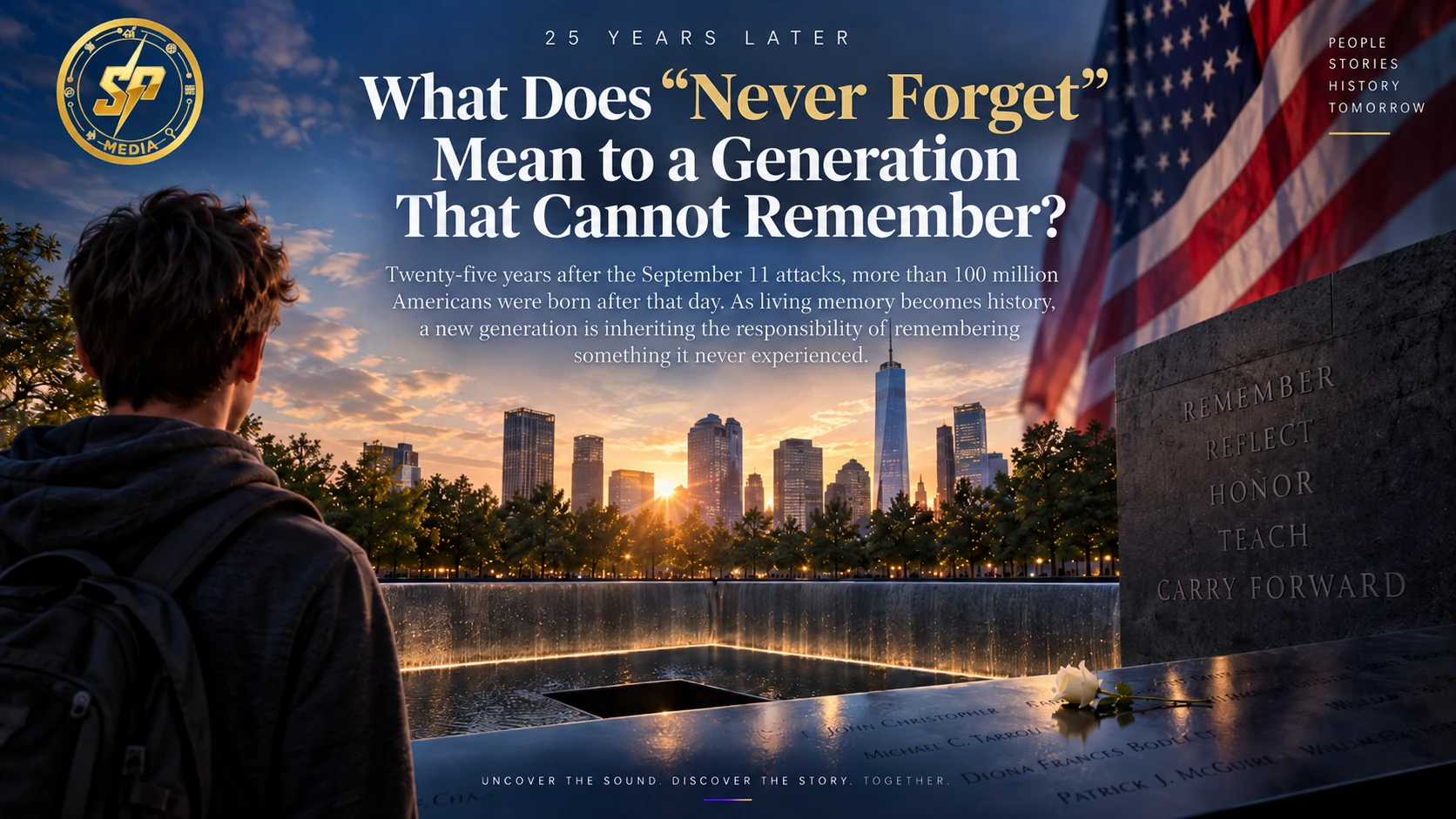
The National September 11 Memorial & Museum estimates that more than 100 million Americans have been born since the attacks or are too young to remember them.
For them, September 11 does not begin with memory.
It begins with history.
And that raises a question that becomes more important with every passing year.
What Does “Never Forget” Mean When You Cannot Remember?
For someone who experienced September 11, "Never Forget" can be deeply personal.
There may be a face attached to it. A place. A conversation. A photograph. A sound. A story told by someone who was there.
But a student learning about September 11 in a classroom today may have none of those memories.
Many were born years after the attacks.
Their understanding comes from teachers, parents, museums, photographs, recorded broadcasts, historical documents and the testimony of people who experienced that day.
That difference does not necessarily make the history less meaningful.
But it changes how the memory reaches them.
The challenge is no longer only preserving people's memories of September 11.
It is transmitting those memories to people who never had them.
Turning Memory Into Education
That transition is already happening.
For the 25th anniversary, the 9/11 Memorial & Museum has placed particular emphasis on educating the generation that came afterward.
Its educational programs use historical material alongside first-person accounts from survivors, family members, witnesses and responders. Its 2026 Anniversary Digital Learning Experience brings those materials into classrooms and gives students an opportunity to engage with Museum educators.
That combination matters.
Dates and statistics can establish what happened.
Personal testimony can help another generation understand what experiencing it meant to the people who were there.
Those are different forms of evidence, and they should not be confused.
A survivor's memory is authoritative as an account of that person's experience. Broader historical claims still require independent verification.
But preserving those individual experiences becomes increasingly important as September 11 moves further from living memory.
History eventually has to carry what memory once did.
September 11 Is Becoming History, But It Isn't Only History
There is another reason the transition is complicated.
The consequences of September 11 did not end in 2001.
The World Trade Center Health Program currently serves nearly 150,000 responders and survivors across the United States and its territories who were affected by the attacks and their aftermath.
Some continue to live with health conditions associated with their exposure.
That creates an unusual intersection between past and present.
For a teenager studying September 11 today, the attacks happened a quarter-century ago.
For someone still receiving medical care because of what happened, September 11 can remain part of everyday life.
Both realities exist at the same time.
September 11 is entering history for one generation while remaining a present-day reality for many people who experienced its consequences.
Even the Way We Remember Is Changing
The official commemoration itself provides an example.
For years, six moments of silence have marked significant moments from the morning of September 11.
For the 25th anniversary, the 9/11 Memorial & Museum is adding a seventh.
That moment will recognize people who later died from illnesses and injuries associated with September 11 and its aftermath.
It is a small change in the structure of the ceremony, but an important one in what the ceremony remembers.
The passage of time has revealed consequences that could not have been fully understood on September 11, 2001.
Remembrance has expanded with them.
The Story Is Bigger Than Ground Zero
The history also cannot be reduced to the World Trade Center.
The attacks struck New York City and the Pentagon, and United Airlines Flight 93 crashed near Shanksville, Pennsylvania, after passengers and crew members fought back against the hijackers.
At Flight 93 National Memorial, the National Park Service will mark the 25th anniversary with its annual remembrance ceremony and commemorative programming.
That matters to the larger story of generational memory.
A complete understanding of September 11 has to preserve what happened in New York, at the Pentagon and aboard Flight 93, along with the experiences of the people connected to each.
Otherwise, remembering can gradually become simplifying.
And simplifying history can eventually mean losing pieces of it.
First-Person Stories Become Historical Bridges
There is something uniquely powerful about hearing history from someone who experienced it.
A photograph can show a place.
A timeline can establish a sequence.
An archive can preserve documents.
But a person can explain what it felt like to stand there.
The 9/11 Memorial & Museum has made first-person accounts an important part of its educational work for precisely that reason.
For students born after September 11, those accounts can become bridges between historical fact and human experience.
That does not mean memory is infallible.
It does not mean every recollection establishes every historical fact associated with it.
It means testimony preserves something a chronology alone cannot.
The challenge for the generations that follow is to preserve both.
The facts tell us what happened.
The people who lived through it can help us understand what that history meant to them.
Memory Does Not Have to End With Memory
There is another way September 11 has been carried forward.
In 2009, Congress established September 11 as a National Day of Service and Remembrance.
That added another dimension to the idea of remembering.
Memory could become action.
For someone born years after September 11, remembrance does not have to depend upon being able to recall the day.
It can mean learning the history.
Listening to the people who experienced it.
Remembering those who were killed.
Recognizing those still living with its consequences.
Serving a community.
And making sure the history is passed accurately to somebody else.
Those actions do not recreate personal memory.
They create continuity.
A Generation Is Inheriting a Memory It Never Had
Twenty-five years is an unusual distance from a historic event.
It is long enough for an entire generation to have grown up afterward, but close enough that millions of people can still describe September 11 from personal experience.
We are living in the overlap between those two eras.
One generation can still say:
I remember.
Another can only say:
I learned.
Eventually, the second group will become the larger one.
That does not necessarily mean September 11 will be forgotten.
But it means remembering will increasingly depend upon what is preserved, what is taught, whose stories are recorded and how carefully the history is handed from one generation to the next.
Perhaps that is what "Never Forget" must confront after 25 years.
Not simply whether those who remember September 11 continue remembering it.
But whether those who cannot remember it are given enough of the history, the voices and the human experience to understand why remembering it matters.