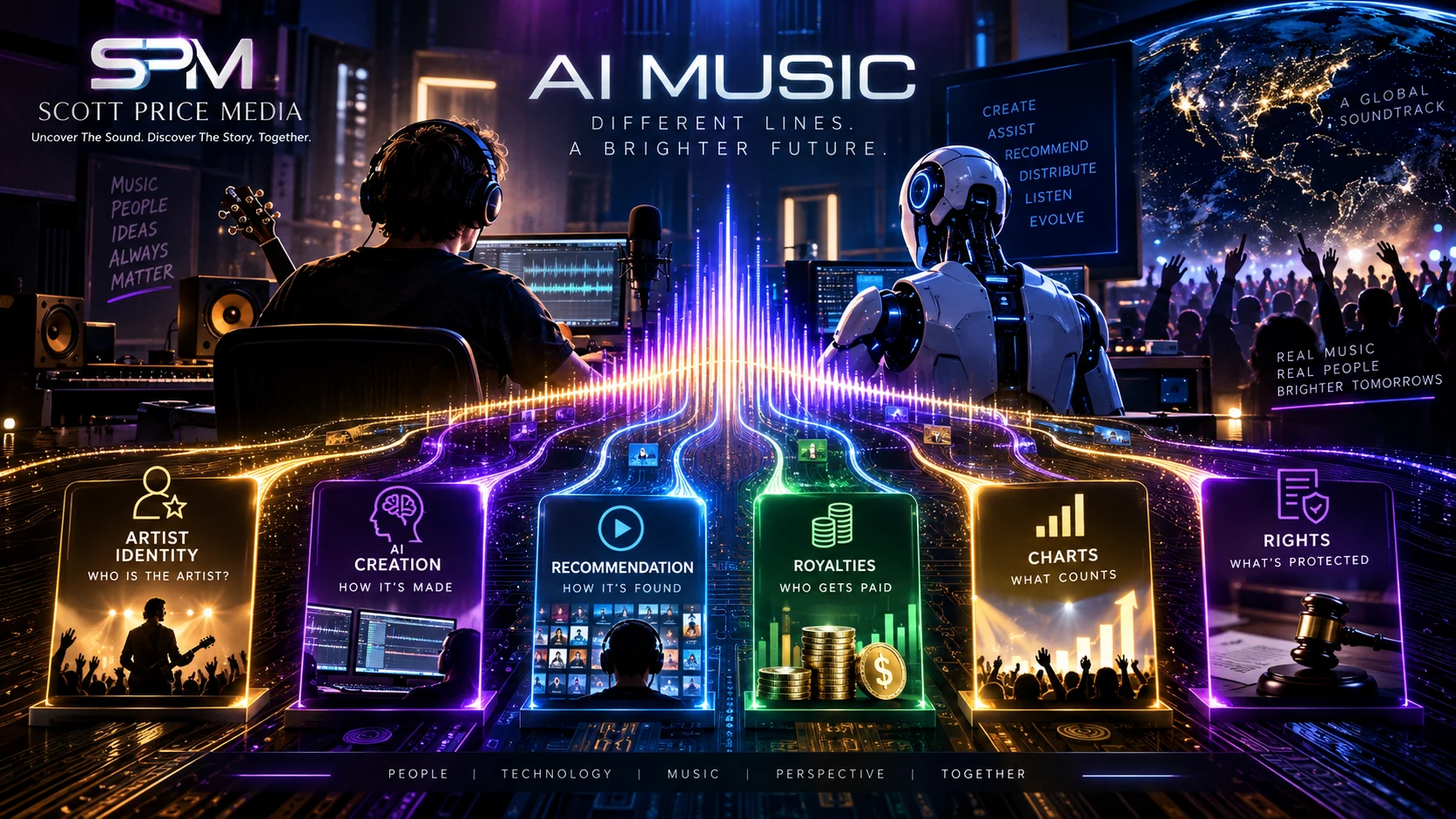
AI music has already arrived. Now the music business has to decide what that actually means.
Is an AI artist the same thing as AI-generated music? How much human involvement makes a recording human-made? Should AI-generated music be recommended to listeners, earn royalties or qualify for the charts? And when an AI system resembles a real artist, who decides whether a legal line has been crossed?
Those may sound like variations of the same question.
They aren't.
Across streaming services, music platforms and chart organizations, different authorities are beginning to draw different boundaries.
Put those decisions next to each other and something interesting happens.
The music industry is not simply deciding whether AI music is allowed. Different parts of it are deciding entirely different things.
An AI Artist Is Not Necessarily the Same Thing as AI Music
Spotify provides perhaps the clearest example of why the terminology matters.
In August, Spotify announced an AI Persona label for artist profiles whose public identity may be AI-generated rather than representing a real person.
But Spotify made an important distinction: the label concerns who the artist appears to be, not necessarily how the music was made.
Those are separate questions.
A human artist can use generative AI in the creative process without that fact alone making the artist an AI Persona. Likewise, an AI Persona is an identity classification, not automatically a description of every production method used to create the music associated with it.
Spotify also says AI Personas will, by default, be excluded from its editorial and personalized recommendations unless listener actions, such as following the artist, affect that relationship.
That is considerably different from saying Spotify has banned AI music from recommendations.
It hasn't.
Spotify has drawn a boundary around a particular kind of artist identity.
Other Platforms Are Drawing Their Lines Somewhere Else
TIDAL approaches the issue from another direction.
Its AI policy defines AI-generated music broadly as music generated wholly or substantially through generative AI. Yet its current enforcement focuses on recordings identified as wholly AI-generated, reflecting limitations in detection and the possibility of false positives.
TIDAL accepts AI-generated music under its policies, but says music it identifies as wholly AI-generated will not receive royalty attribution.
That distinction matters.
The question is no longer merely, "Was AI involved?"
How much AI was involved? What did the AI create? And what consequence should follow from that classification?
Bandcamp provides an even sharper contrast. Its policy prohibits music and audio generated wholly or substantially by AI.
So two platforms can encounter broadly similar technology and establish very different boundaries around it.
One permits AI-generated music subject to conditions.
Another says substantially AI-generated music does not belong on its platform.
Neither policy, however, establishes a universal definition for the rest of the music business.
More Than Half the Uploads? Look Closely at That Number
Then there is Deezer.
The company reported that at peak levels during June 2026, tracks its detection system classified as fully AI-generated represented more than 50 percent of new daily music deliveries to the platform.
That number sounds enormous.
It is.
But it does not mean more than half of the music people listened to was AI-generated.
Deezer separately reported that fully AI-generated music represented only about 1 to 3 percent of total streams.
That difference may be one of the most revealing statistics in this entire discussion.
AI tools can make it possible to generate and deliver music at tremendous scale. That does not mean listeners are consuming it at anything close to the same scale.
There is another qualification worth remembering.
Deezer says its detection system achieves 99.8 percent accuracy, but that accuracy figure comes from Deezer itself, and SPM has not independently validated the detector.
So the most accurate description isn't that SPM somehow counted 90,000 AI tracks ourselves.
Deezer says its system was detecting roughly 90,000 fully AI-generated tracks per day during June.
That is what the evidence establishes.
AI Music and Fraud Are Also Different Questions
Deezer has reported another striking number. The company says that in 2025, up to 85 percent of streams associated with tracks it identified as fully AI-generated were fraudulent.
That deserves attention.
But it requires another distinction.
AI-generated does not mean fraudulent.
Fraud describes behavior surrounding a recording or its streams. AI generation describes something about how the recording was created.
Those properties can overlap. They are not interchangeable.
That distinction matters beyond Deezer. Platforms increasingly have to determine not only whether AI was involved, but whether listening activity itself is legitimate.
A system that treats "AI-generated" as another word for "fraudulent" would answer the wrong question before the investigation even began.
Where Does AI-Assisted End and AI-Generated Begin?
Music charts are confronting another boundary.
The International Federation of the Phonographic Industry has introduced principles for determining the eligibility of recordings involving generative AI within its chart network.
In Australia, ARIA subsequently established its own chart rules under which wholly AI-generated tracks are not eligible for the ARIA Charts, while qualifying AI-assisted recordings can remain eligible.
That distinction gets surprisingly specific.
ARIA's guidance distinguishes an AI-generated lead vocal from AI-generated backing vocals supporting a human lead. It also treats production uses of AI differently from AI creating primary musical elements.
Again, the important question isn't simply:
Was AI used?
It is:
What did the AI do?
That may become one of the defining questions of AI-era music.
AI can potentially participate in writing, vocals, instrumentation, production, mastering, artwork, identity and distribution. Treating every one of those uses as the same thing quickly becomes inadequate.
And Then There Is the Question of Who Gets to Be an Artist
This may be where the debate becomes most complicated.
Technology companies can decide what their platforms will distribute, recommend, label or monetize. Chart organizations can determine what qualifies for their rankings.
But neither automatically decides what an artist legally owns about their identity.
Artists have already brought legal challenges involving generative-AI systems and questions surrounding identity, likeness and other protected rights.
Those disputes raise a different set of questions from the platform policies examined here.
One pending federal case involving Suno raises allegations concerning artists' identities and publicity rights.
Those allegations remain unresolved.
Suno, for its part, says its tools are intended to enable original creation rather than artist imitation. The company says it excludes artist names from training metadata, redirects artist-specific prompts toward descriptions of musical characteristics and prohibits unauthorized use of another person's voice or likeness.
SPM has verified that Suno publicly makes those statements.
We have not independently audited Suno's underlying systems to establish that every technical safeguard operates exactly as described.
That difference is important too.
Maybe "AI Music" Is the Wrong Question
After looking across these policies, classifications and disputes, the most interesting conclusion may be that asking whether something is simply "AI music" doesn't tell us very much.
We need another question immediately afterward:
What do you mean by AI music?
Are we talking about an artificial artist identity?
A human musician using an AI production tool?
An AI-generated lead singer?
AI backing vocals?
A completely generated recording?
A recommendation algorithm deciding whether listeners should hear it?
A platform deciding whether it earns royalties?
A chart organization deciding whether it represents enough human creation to qualify?
Or a court deciding whether somebody's legally protected rights were crossed?
Those are not one question.
And across the organizations SPM examined, they are producing different answers.
The Lines Are Being Drawn in Real Time
Streaming didn't require listeners to stop loving physical music. Digital recording didn't make guitars disappear. Synthesizers didn't end human musicianship.
Generative AI may eventually become another tool in that long history.
Or some uses of it may prove fundamentally different.
The evidence does not yet give us the right to declare which future wins.
What we can see is that the boundaries are already forming.
Spotify is confronting artist identity. TIDAL is confronting creation and payment. Deezer is confronting detection, recommendation and fraud. Bandcamp has drawn a distribution boundary. Chart organizations are defining what qualifies for recognition, while artists and courts are confronting questions involving rights.
The result isn't one definition of AI music.
It is a collection of decisions about what matters when AI enters music.
And perhaps that is the story unfolding in front of us.
Before the music business can decide where AI belongs, it first has to decide what, exactly, it is deciding.