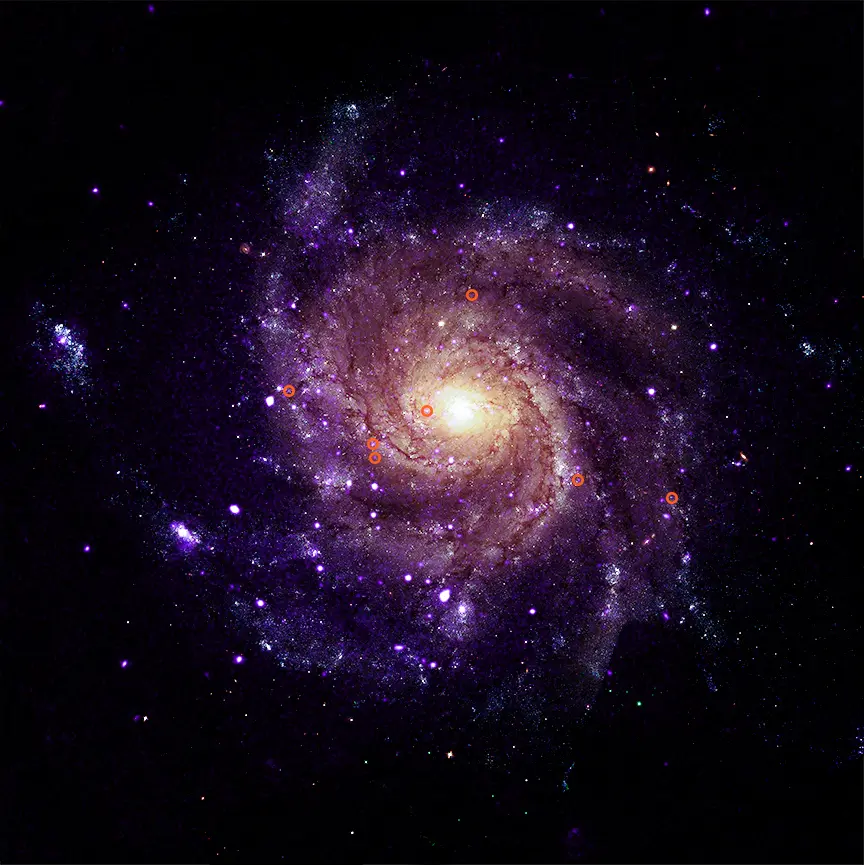
Astronomers examining observations from NASA’s Chandra X-ray Observatory have identified a mysterious new class of cosmic sources that remained hidden despite decades of X-ray research.
The researchers found 84 objects across six nearby galaxies. Named “hypersoft X-ray sources,” they stand out because nearly all of their detected X-rays appeared at exceptionally low energies.
The discovery was detailed in a peer-reviewed study published September 9 in Nature Astronomy.
Unlike typical X-ray binaries, which emit much of their radiation at higher X-ray energies, these sources were detected primarily or exclusively below 0.3 kiloelectron volts. Some disappeared entirely when researchers examined images at higher energies.
That unusual signature may point toward something even more difficult to observe.
Hidden near an astronomical blind spot
Low-energy X-rays sit beside extreme-ultraviolet radiation on the electromagnetic spectrum. Based on models of the objects’ emissions, the researchers concluded that much of their energy may emerge as extreme-ultraviolet light.
This ultraviolet output was not directly observed by Chandra. It was inferred from models based on the X-ray measurements.
Observing this region of the spectrum is especially difficult because hydrogen and helium absorb extreme-ultraviolet radiation. That gas can create a barrier between an object and a telescope, concealing much of the energy before it reaches the observer.
Chandra also has limited sensitivity at the lowest X-ray energies. By carefully examining publicly available archival observations, the research team was able to investigate a region of the spectrum that previous surveys had largely missed.
The sources were found in the spiral galaxies M31, better known as the Andromeda Galaxy, and M101, known as the Pinwheel Galaxy. Researchers also identified them in four elliptical galaxies.
They appeared in areas of active star formation as well as regions populated by older stars. That range of environments suggests the 84 sources may not all share the same physical origin.
What could these objects be?
The objects’ identities remain uncertain.
Researchers suspect that many may be binary systems in which a compact stellar remnant pulls material from a companion star. The compact object could be a white dwarf, neutron star, or black hole.
As material falls toward one of these objects, it heats up and releases radiation. Known X-ray binaries usually produce stronger emissions at higher X-ray energies, however, making the extremely soft emissions from this population unusual.
The study proposes several possible explanations, including accreting white dwarfs, systems observed after nova eruptions, and systems containing accreting black holes. A separate theoretical paper has proposed that some of the most luminous examples could involve two black holes orbiting inside a larger three-star system.
These possibilities remain hypotheses. The current evidence establishes a shared observational class, not one confirmed physical explanation for all 84 sources.
Possible clues to Type Ia supernovae
Some hypersoft sources could help astronomers investigate one of the unresolved questions surrounding Type Ia supernovae.
These powerful stellar explosions are important because astronomers use them to measure cosmic distances and study the expansion of the universe. Scientists know that Type Ia supernovae involve exploding white dwarfs, but the systems and processes leading to those explosions are not fully understood.
Some accreting white dwarfs or post-nova systems within the newly identified population could represent possible stages along that path.
The discovery does not establish that hypersoft sources become Type Ia supernovae. Instead, it gives astronomers another population of objects to study while searching for possible progenitor systems.
Energy that could influence entire galaxies
The sources may also contribute to the ionization of gas between stars.
Ionization occurs when atoms lose electrons. This process affects the physical conditions inside galaxies and can influence their evolution. Hot, massive stars provide some of the necessary ultraviolet radiation, but they may not account for all of the ionized gas astronomers observe.
If hypersoft sources produce as much extreme-ultraviolet energy as the models suggest, they could represent an additional source of that radiation.
Researchers have not yet established how much these objects contribute. The newly identified population instead presents a possible part of the explanation that can now be tested through further observations and modeling.
A discovery built from existing observations
The 84 sources were not found during one new observing campaign. They emerged from a fresh examination of information already stored in the Chandra Data Archive.
That makes the discovery an example of how scientific archives can retain unanswered questions long after observations are first collected. New methods and new questions can reveal patterns that earlier surveys were not designed to find.
The detected sources may also represent only a fraction of the real population. Their low-energy emissions are difficult for current X-ray telescopes to detect, while the ultraviolet radiation researchers believe they produce is readily absorbed before reaching Earth.
For now, astronomers have identified the signature without fully identifying what creates it.
That uncertainty is not a weakness in the discovery. It is the beginning of the next investigation.
The observations have revealed an overlooked population of energetic cosmic sources. Determining what those sources are, how many remain hidden, and whether they contribute to larger processes inside galaxies will require further study.
The universe has not yet given astronomers the full answer. Chandra has shown them where to begin looking.