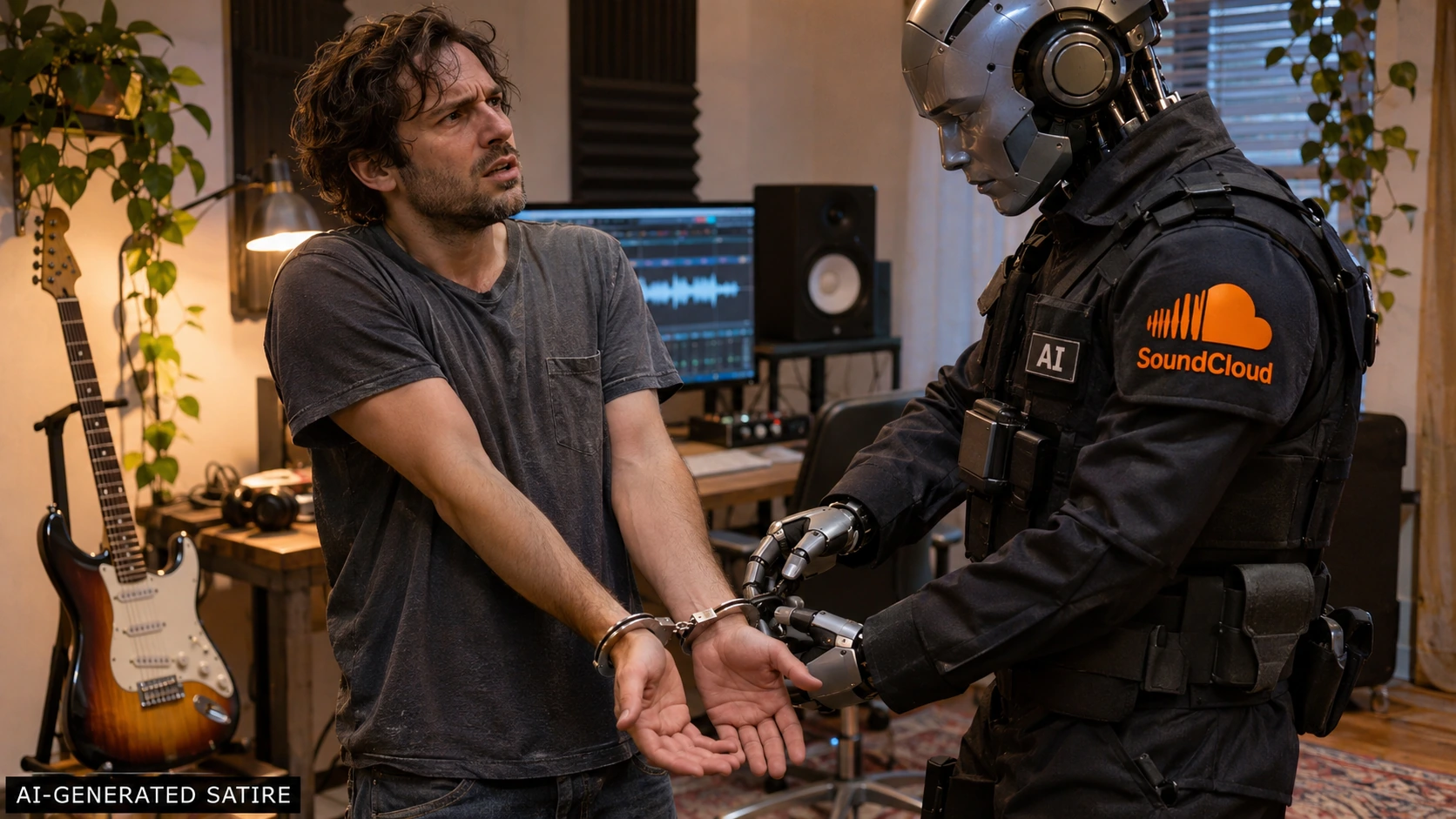
For independent musicians, including those who use AI, a platform’s decisions can determine whether a recording stays available. Artists need to understand what crosses the line and how the platform establishes a violation.
That puts a central question before artists and listeners: Can platforms welcome new creative tools while keeping discovery fair and artist identities trustworthy?
What SoundCloud is proposing to prohibit
The AI Abuse section displayed in SoundCloud’s Community Guidelines addresses unauthorized voice or likeness use, artificial engagement, and misleading representations of AI-generated work or artist identities. Its examples include generating near-duplicate tracks to manipulate earnings and presenting an AI persona as a human artist. [2]
One hypothetical example is someone cloning a musician’s voice without permission and promoting the recording as that musician’s new release. Another is an operator generating tracks in bulk and using bots to manufacture popularity. These illustrate prohibited conduct; neither is an incident established by this reporting.
There is also a timing qualification. The live Terms of Use and Community Guidelines both display an amendment date of December 1, 2026, after this article’s November 23 research date. The terms also describe a notification period for significant changes. The announcement and published text establish SoundCloud’s stated direction, but do not settle when every new provision applies to individual users. [2][3]
Creative access and fair competition
SoundCloud continues to promote AI tools, including services for song generation, stem separation, and music production. ElevenLabs also advertises an integration that lets creators publish ElevenMusic tracks directly to SoundCloud. [4][5]
This leaves room for openly disclosed AI projects. Disclosure helps listeners understand what they are hearing. An artist can describe a generated recording honestly while competing for attention with musicians who take a different approach to writing and recording.
Whether the discovery system gives those creators fair treatment requires evidence about how recommendations and enforcement operate.
The materials reviewed for this article do not establish that the announced changes have improved independent musicians’ reach or earnings. Nor do they establish that allowing AI music necessarily reduces those opportunities.
Who makes the decisions?
SoundCloud’s general moderation policy identifies its Trust & Safety team as the reviewer of complaints. Reports must contain a substantiated explanation, a content URL, contact details, and confirmation that the allegations are accurate. [6]
The policy also describes automated detection that can refer content for review or lead to automatic action. It does not support an assurance that a human examines every suspected violation before a restriction occurs. These are the company’s published procedures, rather than independently audited findings about their operation. SoundCloud’s moderation policy provides the relevant framework. [6]
The reporting requirements explain how to submit an allegation. The materials reviewed do not establish what evidence SoundCloud requires to determine AI deception, whether a detection result alone can justify action, or what documentation demonstrates permission to use a disputed voice.
SoundCloud’s own help guidance acknowledges that fake accounts can engage with an artist’s work without that artist arranging it. It also says activity may mistakenly reach an account for which it was not intended. A suspicious increase in plays therefore warrants investigation, but does not establish who caused it. [7]
What happens when SoundCloud gets it wrong?
There are safeguards that give artists a route to challenge a decision. Their value depends on the quality and speed of the review, particularly when an account or income is affected.
SoundCloud’s published moderation policy says appeals are assigned to a party other than the original decision-maker. It also says successful content appeals result in restoration. Artists should receive appeal instructions in the relevant notification. [6]
SoundCloud acknowledges that original recordings can be incorrectly identified and directs artists to supply ownership or permission information for its copyright team to assess. This guidance concerns copyright disputes; it does not establish how every AI-related appeal is handled. [8]
Further explanation of AI accusations would help artists understand when human review occurs, what evidence they can submit, and how successful appeals affect withheld earnings and account standing.
The accountability test
The next test is whether artists can understand and challenge decisions made under SoundCloud’s framework. Clear evidence standards and meaningful explanations would help the public assess whether the system deserves its trust.
SoundCloud’s approach needs to support independent musicians experimenting with AI, protect artists against impersonation, and help listeners understand who and what they are hearing.
Reporting note: This draft examines published policies and company statements. SoundCloud has not been contacted for clarification. AI-specific enforcement outcomes and the effective timing of the newly displayed provisions remain unverified.
Sources
- Statement attributed to SoundCloud CEO Eliah Seton, “AI Is Changing Music. Its Future Must Be Built Around Artists,” reproduced guest column, November 17, 2026. Read source 1
- SoundCloud, Community Guidelines. Live page displays a December 1, 2026 amendment date; effective timing remains unverified. Read source 2
- SoundCloud, Terms of Use. Live page displays a December 1, 2026 amendment date; effective timing remains unverified. Read source 3
- SoundCloud, AI Partnerships and Integrations. Read source 4
- ElevenLabs, “Share your ElevenMusic creations directly to SoundCloud,” published November 6, 2026; updated November 23, 2026. Read source 5
- SoundCloud, Content Moderation and Enforcement Policy, sections 2, 3 and 6; page displays January 15, 2024 amendment date. General procedures, not an AI-specific evidence protocol. Read source 6
- SoundCloud Help Center, “Reporting fake activity.” Read source 7
- SoundCloud Help Center, “My own content was flagged for copyright infringement and blocked.” Copyright-specific guidance. Read source 8