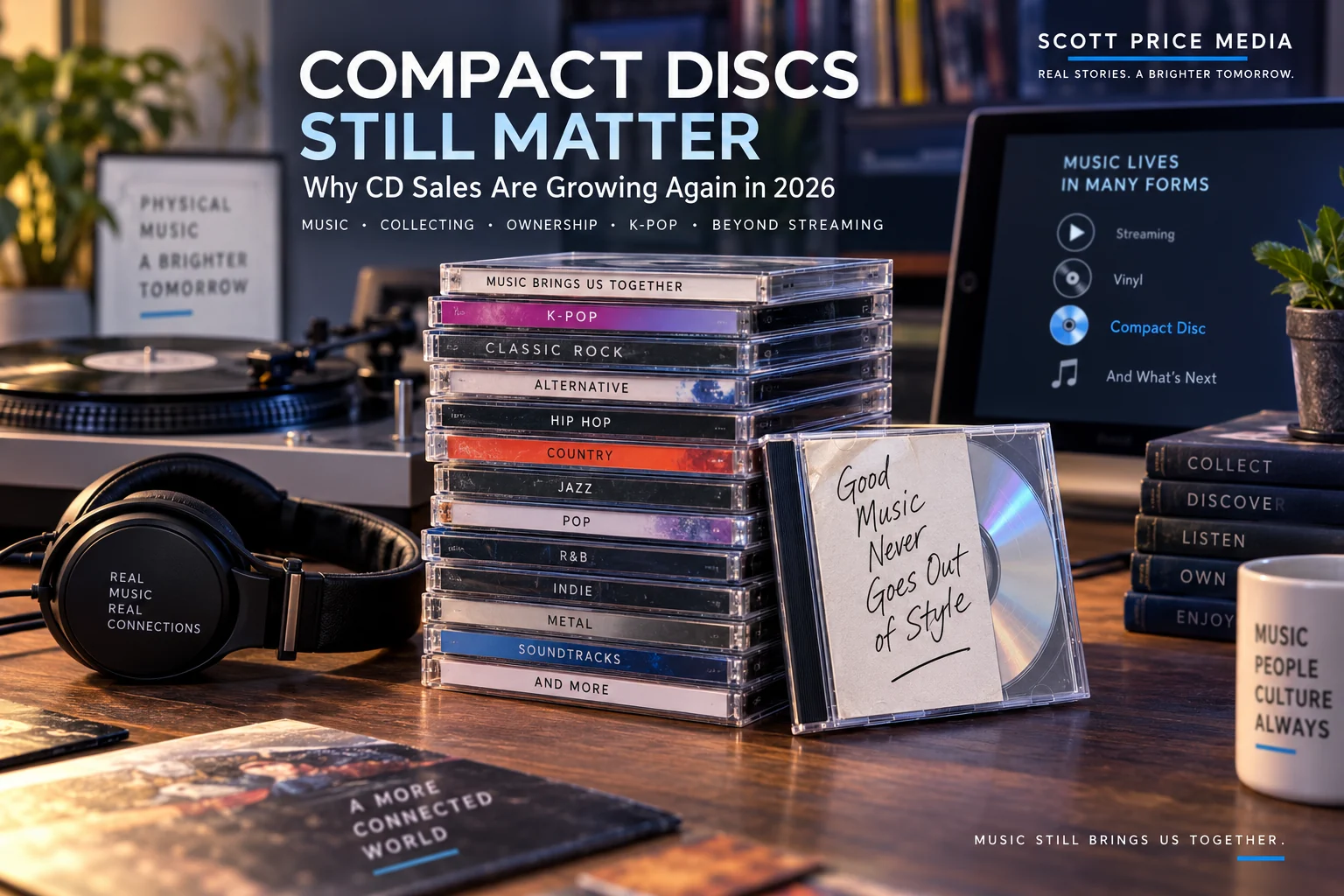
For years, the compact disc seemed destined to become another artifact of music's technological past.
Streaming put millions of songs into our pockets. Vinyl found new life as the premium physical format for collectors and devoted music fans. Meanwhile, countless CDs ended up packed into boxes, stacked on thrift-store shelves or gathering dust beside players that hadn't been turned on in years.
Then something interesting happened.
People started buying more CDs again.
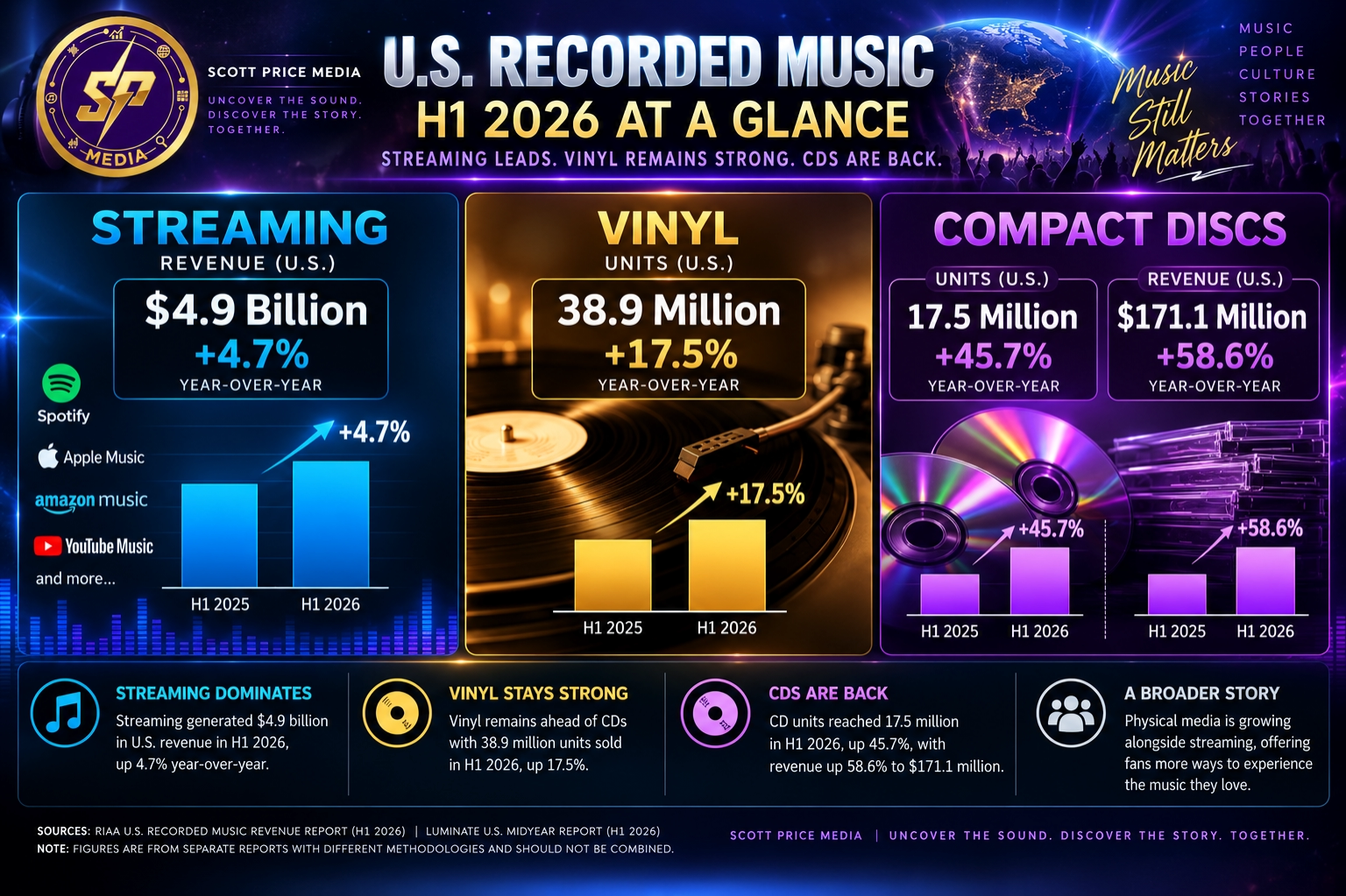
According to Luminate's 2026 Midyear Report, U.S. CD sales increased 16% during the first half of 2026, reaching 16.3 million units.
Separate figures from the Recording Industry Association of America paint an even more dramatic picture. Multiple publications reporting on the RIAA's first-half 2026 data put CD units at 17.5 million, with CD revenue reaching approximately $171.1 million, an increase of 58.6% from the comparable period a year earlier.
Those figures don't mean the CD is about to reclaim the music industry.
They do give us a good reason to ask a question few people expected to be asking again:
Why are people buying CDs in the age of streaming?
First, Let's Not Call Streaming Dead
There is an easy headline to write here.
CDs are back. Streaming is out.
It would also be wrong.
Streaming generated approximately $4.9 billion in U.S. recorded-music revenue during the first half of 2026 and continued to grow.
Compared with approximately $171 million in CD revenue reported in the RIAA figures, the scale isn't close.
Streaming remains the dominant way recorded music generates revenue in the United States.
Vinyl isn't disappearing either.
The latest RIAA figures put vinyl substantially ahead of CDs in both units and revenue. This isn't a story about one old format knocking another one off the shelf.
Something more interesting appears to be happening.
Instead of choosing between streaming and physical music, some listeners may be finding reasons for both.
K-Pop Is Part of the Story, But Not All of It
One of the clearest explanations for the increase comes from K-pop.
Luminate specifically points to collectible K-pop releases as an important contributor to CD growth.
That makes sense when you consider what a physical album can represent to a dedicated fan.
The product doesn't necessarily begin and end with the music stored on the disc. Packaging, artwork and other collectible elements can turn an album into something connected to the artist and the fan community surrounding them.
But this is where the numbers become especially revealing.
Luminate calculated that if K-pop were removed from its U.S. CD figures, CD sales still would have increased 6.7%.
In other words, K-pop helped accelerate the growth.
It didn't create all of it.
That suggests there is a broader story worth uncovering.
Maybe We Don't Have to Choose Between Access and Ownership
Streaming solved an enormous problem for music listeners: access.
For a monthly subscription, or through ad-supported services, listeners can instantly explore an amount of music that would have been unimaginable when CDs dominated record-store shelves.
But access and ownership aren't necessarily the same experience.
A streaming library is incredibly convenient. A physical album is something you can hold, display, collect, give to someone or keep on a shelf for years.
Those experiences don't have to compete.
A listener can discover an artist through streaming, listen to that artist every day through a phone and still decide that a particular album means enough to own physically.
That possibility may help explain why physical media can grow without requiring streaming to decline.
The future of music consumption might not be a battle between physical and digital after all.
It could be a combination of the two.
Before Declaring a CD Renaissance, Look Back One Year
There is another reason to keep the celebration in perspective.
CD sales didn't march steadily upward into 2026.
RIAA's full-year figures show U.S. CD units falling from approximately 33.3 million in 2024 to 29.5 million in 2025, an 11.6% decline.
During the first half of 2025, the decline was even sharper compared with the same period in 2024.
That matters.
The impressive growth we're seeing during the first half of 2026 is therefore better described, for now, as a strong rebound rather than proof of a permanent renaissance.
If CD sales remain strong through the rest of 2026 and continue growing beyond it, the longer-term picture will become much clearer.
For now, one strong half-year deserves attention.
It doesn't deserve a crystal ball.
Two Reports, Two Different Numbers
Readers looking into the CD story may encounter another confusing detail.
Why does Luminate report 16.3 million CDs while RIAA figures reported by industry publications put the number at 17.5 million?
It is important not to treat the figures as though they came from identical measurement systems.
Luminate and RIAA collect and report music-industry information using different methodologies and data sources. Their numbers therefore shouldn't be combined, averaged or presented as contradictory measurements of exactly the same thing.
For Scott Price Media, the responsible approach is simple:
Tell readers which organization produced each number.
Numbers without context can create a headline.
Numbers with context can tell a story.
The Compact Disc May Have Found a Different Job
When CDs became the dominant music format decades ago, their job was straightforward.
They delivered the music.
Today, streaming does that job extraordinarily well.
Perhaps the more interesting question isn't whether CDs can somehow defeat streaming.
It's whether the role of the CD itself is changing.
For some listeners, a CD can still be the way they listen to an album. For others, the physical release may represent ownership, artwork, collectibility, fandom or a tangible connection to music that exists alongside the convenience of streaming.
The current data doesn't prove exactly how large each of those motivations is across the entire market, and we shouldn't pretend that it does.
What the numbers do tell us is that something worth watching is happening.
CD sales have rebounded sharply.
K-pop and collectible releases are helping.
Growth remains even when K-pop is removed from the calculation.
Vinyl remains strong.
Streaming remains dominant.
All of those things can be true at the same time.
Maybe that's the real story.
Music technology has spent decades giving us new ways to replace the old ones.
But listeners don't always cooperate.
Sometimes we keep the new technology and rediscover a reason to bring the old one along with us.