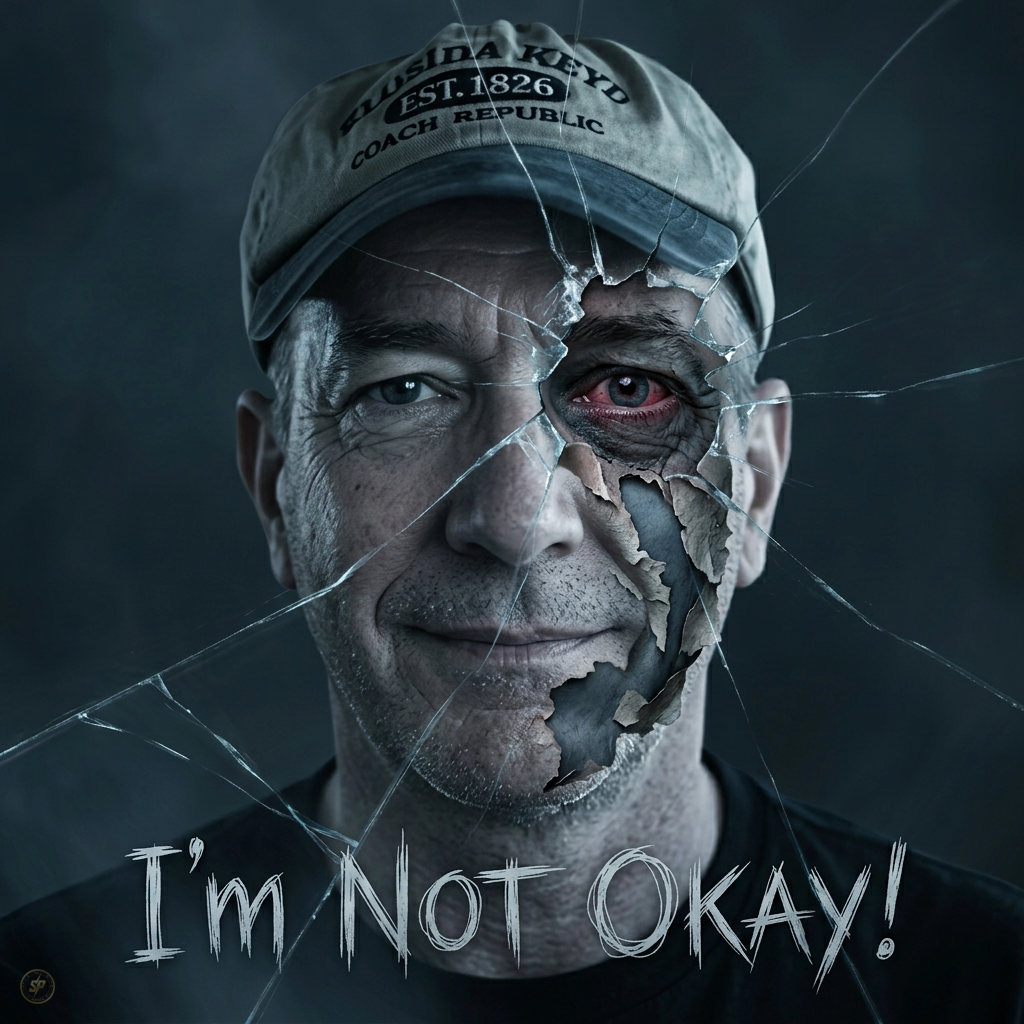
Song Analysis
Thesis: When the Mask Stops Working
Deadfish’s “I’m Not Okay” follows a narrator who wants someone to recognize his distress even as he hides it. The verses show how easily he can be misread. The hook asks another person to reach him, and the chorus finally gives that person a direct answer. Across the song, the struggle to be understood becomes as important as the dread itself.
1. The Eyes Reveal What the Face Conceals
The first verse makes two apparently contradictory claims. The dread is visible in the narrator’s eyes, yet the person he addresses thinks he’s okay. The explanation follows immediately: the narrator admits that he keeps his true face hidden.
Eyes and face usually tell us the same thing. Here they pull in different directions. The eyes let something slip that the narrator’s outward composure covers over. The listener can recognize a familiar difficulty in that gap: someone can show signs of struggling without feeling ready to explain what those signs mean.
The opening rhymes help hold the contradiction together. “Eyes” and “survive” connect what another person might notice with the effort it takes the narrator to get through the day. “Okay” and “face” then connect the other person’s impression with the appearance the narrator presents. The verse ends with the misunderstanding still in place.
2. The Hook Turns Inward, Then Reaches Out
The hook shifts from what can be seen to what the narrator feels inside his head. The image of being trapped turns thought into a place he cannot easily leave. Dread returns at the end of the hook, echoing the opening line and bringing the song back to the feeling it started with.
There’s an unsettled shift from “you” to “I.” The first line could bring the listener into a shared feeling of helplessness, or it could describe how the person being addressed sees the situation. Either way, the movement ends in a direct question to another person. After withholding what he feels in the verse, the narrator now asks for help.
His wish to see a happy ending gives the hook a different kind of tension. He can imagine a future beyond what he feels now, but the song gives him no certainty about how to reach it. That brief glimpse of a different outcome makes the appeal more urgent.
3. The Chorus Finally Says It Plainly
The opening verse tells us what someone else thinks. The chorus answers with the narrator’s own account: “I’m not okay.” The words are short enough to remember and plain enough that the listener no longer has to interpret an expression or a change in behavior.
The first chorus repeats the same line four times in the supplied lyrics. The verses and hook use images and questions to explain the feeling. The chorus leaves all that explanation behind. Repeating the phrase can sound like an insistence on being heard, or like someone trying to keep saying a difficult thing once he has finally said it aloud.
The title phrase also enters the end of the second verse before the chorus formally returns. By then, the admission is part of the narrator’s account of what happened. It no longer waits for the chorus.
4. Coldness as Something Felt and Something Seen
The second verse draws a distinction between being heartless and feeling numb. From the outside, the narrator may appear distant. From the inside, he describes a loss of access to his own feelings. The phrase “I may seem” marks the distance between those two accounts.
The coffin image makes that loss feel physical. The head was already an enclosure in the hook. The coffin adds coldness and the suggestion of being shut off from contact. It gives the narrator’s numbness a shape and temperature.
The casual response to being left, “no problem,” recalls the mask from the first verse. It could be an attempt to shrug off a departure or a guarded way of describing it. The admission that follows makes the shrug hard to take as the whole story. The lyric leaves the relationship and the cause of the departure open, so the moment can deepen our understanding of the distress without having to explain all of it.
5. The Bridge Gives the Search for Help a Name
The bridge is just two lines. Hearing, seeing, and feeling arrive in quick succession. The images give the impression of distress coming from several directions at once, and the return of coldness ties the bridge back to the coffin image.
Then the language changes. The narrator mentions seeking treatment. Earlier, he asked a person to save him from his dread. Here, he gives the search for help a more concrete name. The song leaves the outcome open, but that change in wording gives us one indication of what the narrator might do next.
Conclusion
The last hook and chorus bring the narrator back to the same fear and the same admission. In the supplied lyrics, the last chorus is half the length of the first. There is no answer from the person being addressed. What changes is that the narrator has put his experience into words that can be heard. At the beginning, the other person has to read his face. By the end, the narrator has told them how he feels.
Analysis from the Scott Price Media 'Picture Lyrics' Series

Deadfish
Recording artistThe 2019 single pairs the original recording with an acoustic version. Both are listed under Deadfish’s artist credit. Single listing

Raspo
ProducerRaspo includes the original recording in his own playlist of productions, where it is listed at 3:01. Raspo’s production playlist
I'm Not Okay
Deadfish - Single, 2019[Verse 1]
You can see the dread in my eyes
'Cause I'm strugglin' to survive
And you think that I'm okay
'Cause I won't let you see my true face
[Hook]
And you feel like there is no help
Feel like I'm trapped in my own head
I want to see my happy end
Can you save me, from my own dread
[Chorus]
I'm not okay
I'm not okay
I'm not okay
I'm not okay
[Verse 2]
I am not heartless, I just can't feel nothing
I may seem bit cold, like inside of a coffin
You left me, no problem
I've never been flawless
And no, I'm not okay
[Bridge]
Hear the voices, see the demons
Feel the coldness, seeking for treatment
[Hook]
And you feel like there is no help
Feel like I'm trapped in my own head
I want to see my happy end
Can you save me, from my own dread
[Chorus]
I'm not okay
I'm not okay